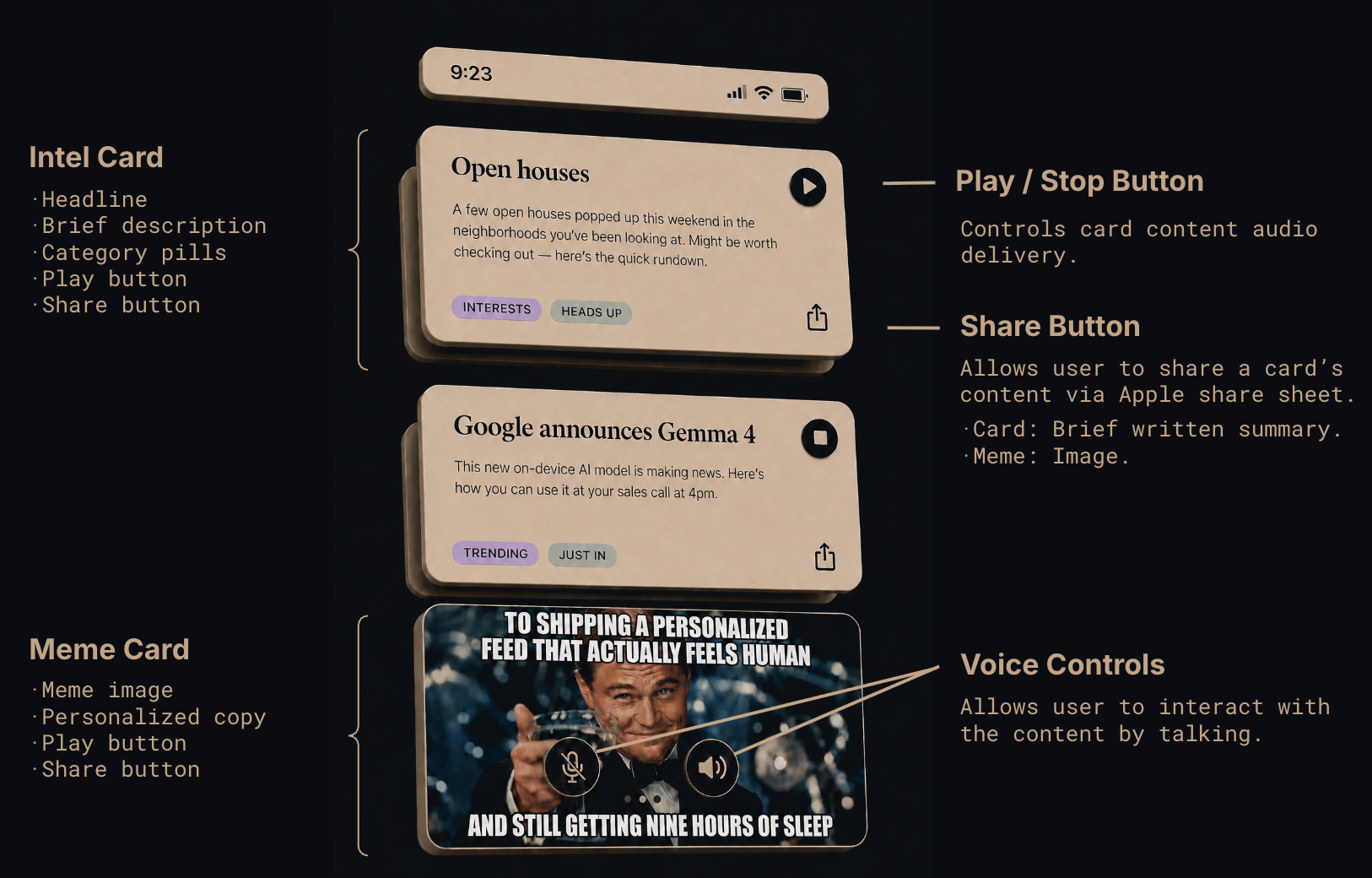
Intel - A new take on the feed.
For many of us, the feed has quietly become one of the main ways we relate to the world. It is where we go to see what is happening, what people think, what matters, what is interesting, what is urgent, what is trending, what we might have missed. It promises connection, information, discovery and perspective.
And yet more and more people know the feeling that something about it is off. You spend hours in a feed and are not quite sure what you actually got. Something catches your interest, but the experience rarely helps you turn that interest into real understanding or action. You stay constantly updated and still feel disconnected from what actually matters in your own life.
Why today’s feeds feel wrong.
That contradiction is everywhere, because feeds are designed to override your intentions. Someone is on the other side of that feed, and their goal is not your wellbeing. It’s to sell your attention to the highest bidder. And so the feed learns, with extraordinary precision, what catches us, what triggers us, what prolongs us, what brings us back. Anything that takes us away is, from its perspective, a loss.
But the cost of the modern feed is not just lost time, though there is plenty of that. It is also the gradual replacement of more meaningful mental and relational spaces where a life gets processed: The meeting you were only half-present for. The thought you almost had but lost to a notification. The friend you saw in your feed but did not actually talk to. The project you keep meaning to start but somehow never find the mental room for. And that produces drift: Drift from your priorities, your own pace of thought, the people around you, and the things that actually matter to you.
This is how a system built for connection can deepen loneliness. How a system built for information can amplify misinformation. How a system built for self-expression can turn identity into performance. How a system built for discovery can erode focus. How a system built to keep us updated can leave us feeling perpetually with the fear of missing out.
The point is not that every feed experience is harmful, or that all digital content is bad. It is that the dominant feed model is optimized around a relationship with information that often works against the user’s deeper interests.
Once you see the design, the experience of using these products changes. That is why so many people feel a low-grade dissatisfaction with these products, even when they keep returning to them. So we asked ourselves: what would a feed look like if it were built on a different premise and judged by a different measure of success?
The problem is not just the content, it’s the interface.
Even a perfect feed, built with perfect intentions, would still fall short of what information should be able to do for a person. The problem with today’s feeds is not just that they are addictive or noisy. It’s that they are incomplete. Here is the argument we think matters most, and the one that took us the longest to sit with clearly: the problem is not only the incentives. It is the interface.
A screen-first feed that demands full visual attention is, by design, competitive with whatever else you might be doing or thinking. It is one-way: you receive, you react, but you do not explore. It learns to infer your taste from your behavior, but behavior is a narrow signal and taste is not the same as life. Your life has goals, routines, priorities, relationships, responsibilities, moods, timing, context. It has moments. It has stakes. A feed may know what grabs you. It usually does not know what serves you. It does not know what you are trying to accomplish, who you are trying to become, who you are trying to stay close to, or what really matters this week. Those outcomes are invisible to the system.
So a better feed would need to do something deeper. That is the standard the next generation of feeds should be held to. And exactly that is the problem Intel is built to solve. Not the corruption of the feed. The ceiling of it.
Introducing Intel
Intel is a personalized stream of voice-first short-stories designed to be relevant, conversational, and useful: guides, alerts, updates, reflections, explanations, and more, shaped not just by what you seem interested in, but by the fuller context of your life:
First, it is voice-first. Information no longer has to compete for your full visual attention. It moves with you through the day instead of requiring you to stop your life to consume it.
Second, it does not just redistribute existing platform content. It dynamically creates customized content across multiple sources, shaping information around what is useful rather than what happens to be available.
Third, it is built from richer context than interests and watch history. Intel reasons from your conversations and integrations with In Ear Voice across goals, plans, people, routines, and other signals: what is happening in your day, who matters to you, what you are trying to do, where you are and more.
Fourth, it connects the dots to your life. So when something surfaces, it tells you why this matters for you, now. Not just “you like this topic,” but “this matters because of your meeting, your goal, your relationship, your location, your routine, your current moment.”
And fifth, it is two-way. When something sparks engagement, that is not the end of the experience. It is the beginning. You can ask follow-up questions, dig deeper and hear another perspective. When something does not land, you can say so.
You're making coffee. Intel surfaces something connected to the meeting you have at noon. Context you didn't know you needed, drawn from a source you wouldn't have found. You ask a follow-up question out loud. It answers. You move on. The whole thing took ninety seconds and you didn't look at a screen once.
Closing Remarks.
We are not trying to win the attention economy. We are trying to opt out of it. The feeds that currently exist are very good at what they do. They will keep getting better at it. But as AI multiplies the volume of what can be produced and ranked, their foundation starts to feel incomplete.
The challenge is no longer just discovery, it is discernment. We need products that can turn abundance into relevance. Not a stream you stare at. Not a habit you feel slightly bad about. Something closer to an inner voice that knows you well enough to tell you what matters, in the moment you can actually use it and then gets out of the way.
Intel is not just a morally superior version of the same thing, it is a different format, built from a different premise: that information should fit into your life, not compete with it.
We think you’ll love it.
-bipin & maikel